Physical Address
304 North Cardinal St.
Dorchester Center, MA 02124
Physical Address
304 North Cardinal St.
Dorchester Center, MA 02124
SEO is no longer just about stuffing keywords into your content. With AI-driven search engines and semantic search becoming the norm in 2026, understanding content clusters and semantic SEO is essential. Websites that implement these strategies gain topical authority SEO, making them more likely to rank higher and provide better user experiences.
If you want your website to dominate search results, you must organize your content smartly, cover topics in-depth, and optimize for context and intent—not just keywords. In this guide, we’ll show you how to structure your content, build clusters, and improve your site’s authority step by step.
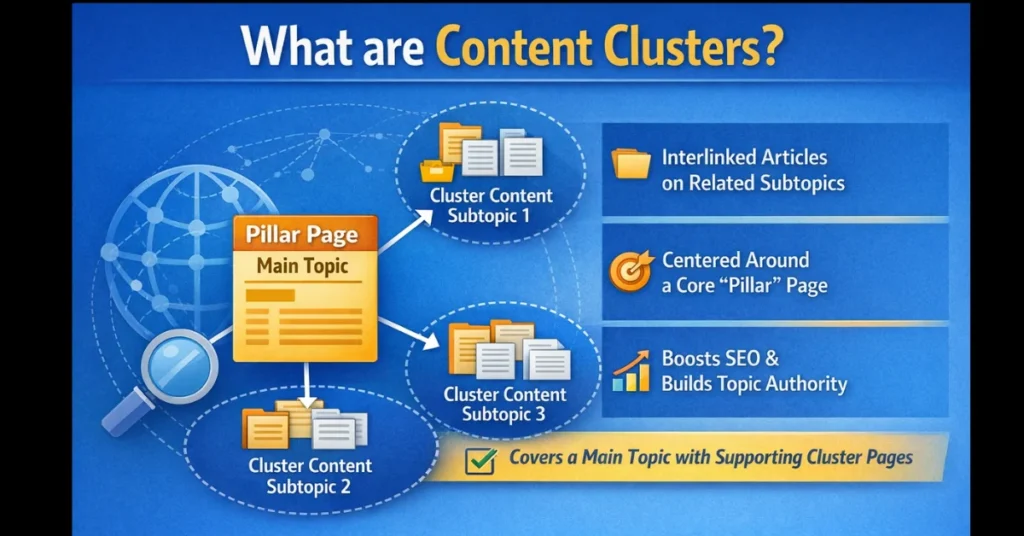
In modern SEO, simply publishing standalone articles is no longer enough to rank well. This is where content clusters and semantic SEO come into play. A content cluster refers to a collection of connected articles that all revolve around a single core topic.
The central element of every cluster is a pillar page, offering a complete overview of the primary subject. Around this pillar page, smaller cluster pages dive deeper into specific subtopics, providing detailed insights while linking back to the pillar.
This setup is called the pillar and cluster model, and it is highly effective for improving both user experience and search engine visibility.
For example, if your pillar page is titled “Ultimate Guide to SEO 2026,” cluster pages could include articles on “Voice Search Optimization,” “Local SEO Strategies,” “Semantic SEO Explained,” and “AI Tools for SEO.”
By linking cluster pages to the pillar and vice versa, a cohesive internal linking system is formed, allowing search engines to easily identify the connection between all pages.
This internal linking not only boosts SEO but also encourages visitors to explore related content, increasing dwell time and reducing bounce rates.
To visualize a content cluster, imagine the pillar page at the center with cluster pages radiating outward like spokes on a wheel. Each spoke represents a cluster page, and the connections between them demonstrate your internal linking strategy.
By combining this approach with semantic SEO, your website establishes strong topical authority, signaling to Google that your content is authoritative and relevant.
Implementing content clusters and semantic SEO through the pillar and cluster model allows websites to organize content efficiently, cover topics comprehensively, and improve overall SEO performance in a structured and strategic way.
Read More: AI-driven keyword research and content planning
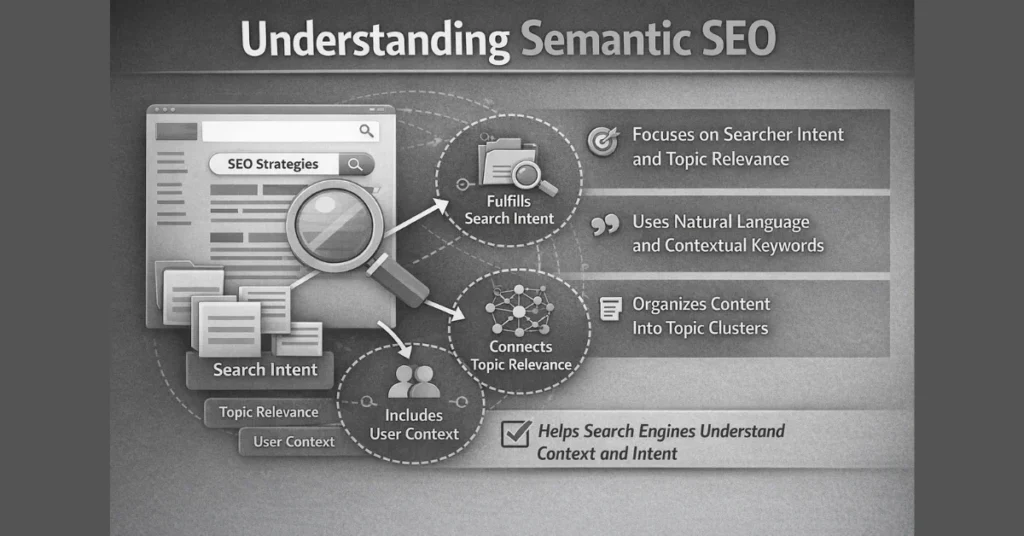
As search engines continue to advance, relying solely on keyword-focused SEO is no longer enough. This is where semantic SEO—or semantic search optimization—becomes essential. Semantic SEO focuses on understanding the meaning and context behind a user’s search query, rather than just matching exact keywords.
By implementing content clusters and semantic SEO, websites can better satisfy user intent, improve engagement, and achieve higher rankings in search results.
Google’s algorithms today prioritize context, intent, and related concepts. This means that the search engine doesn’t just look for the exact words typed by users—it interprets the overall meaning of the query and evaluates related terms, topics, and entities.
For example, if someone searches for “SEO tips,” Google recognizes that related searches like “search engine optimization strategies,” “topic clusters SEO,” “on-page SEO techniques,” and “SEO best practices 2026” are all relevant.
By covering these interconnected topics in your content, you demonstrate to Google that your page is trustworthy, in-depth, and closely aligned with the subject matter.
One of the best ways to implement semantic SEO is through topic cluster SEO. Within a content cluster, the pillar page offers a general overview of the main topic, while the supporting cluster pages dive deeper into specific related subtopics.
This setup seamlessly integrates semantic keywords, helping Google recognize the connections between individual pages and the broader subject they cover.
In essence, semantic search optimization helps your website move beyond keyword matching and focus on creating content that satisfies user intent. When combined with content clusters and semantic SEO, this approach strengthens your site’s topical authority, improves visibility in search results, and ensures that your content remains relevant as Google’s algorithms become increasingly sophisticated.
Combining content clusters and semantic SEO creates a powerful strategy for dominating search results and building topical authority SEO. While a pillar page covers the main topic comprehensively, cluster pages dive into related subtopics, forming a structured network of interlinked content.
This is where the pillar-cluster framework truly shines—it structures content in a way that makes perfect sense to both readers and search engines.
By implementing semantic search optimization, each cluster page not only targets specific keywords but also incorporates related concepts and phrases, helping Google understand the context and intent behind your content.
For example, a pillar page on “Ultimate Guide to SEO 2026” may have cluster pages covering “Voice Search Optimization,” “AI SEO Tools,” and “Topic Clusters SEO.”
Connecting all cluster pages to the pillar page—and linking back—builds a powerful internal linking framework that shows search engines your content is detailed, relevant, and trustworthy.
This combination of content clusters and semantic SEO enhances your SEO content structure. Visitors can easily navigate from general information to detailed subtopics, improving dwell time and engagement.
At the same time, Google recognizes the relationship between pages, boosting your site’s visibility for multiple related queries.
Ultimately, using this integrated approach ensures your website is not just keyword-rich but contextually rich, covering a topic from every angle. Over time, this strategy builds topical authority SEO, positioning your site as an expert source and increasing your chances of ranking for both primary keywords and related search terms.
Building content clusters and semantic SEO into your website may sound complex, but following a structured approach makes it manageable and highly effective.
By implementing the pillar and cluster model, you can create an organized SEO content structure that enhances topical authority SEO and improves user experience.
Start by selecting a comprehensive subject your readers are interested in; this serves as the base pillar page for your cluster. For example, a pillar could be “Ultimate Guide to SEO 2026.”
Research related topics and long-tail keywords that support your main topic. Each subtopic becomes a cluster page. Examples: “Voice Search Optimization,” “Local SEO Strategies,” or “Semantic SEO Explained.” This naturally incorporates semantic search optimization into your content.
Write a comprehensive, detailed pillar article that covers the main topic extensively. Ensure it includes links to each cluster page and naturally integrates your main key phrase.
Each cluster page should focus on a specific subtopic, providing depth and actionable insights. Connect every cluster page to the main pillar page and, when appropriate, interlink related cluster pages with each other. This forms a strong internal linking strategy that signals topical relevance to Google.
Include related terms, contextually relevant phrases, and supporting keywords in both pillar and cluster pages. By covering different aspects of your core topic, you enhance the SEO strength of your topic clusters and increase the likelihood of ranking for various related search terms.
Regularly review and update both pillar and cluster pages. Add new cluster pages as trends evolve to maintain your topical authority, SEO, and ensure your SEO content structure remains current and comprehensive.
By following this step-by-step guide, your website will not only rank better in Google’s AI-driven search results but also provide a structured, engaging experience for your readers. Applying semantic SEO and content clustering elevates your site’s reputation as a leading authority in your field.
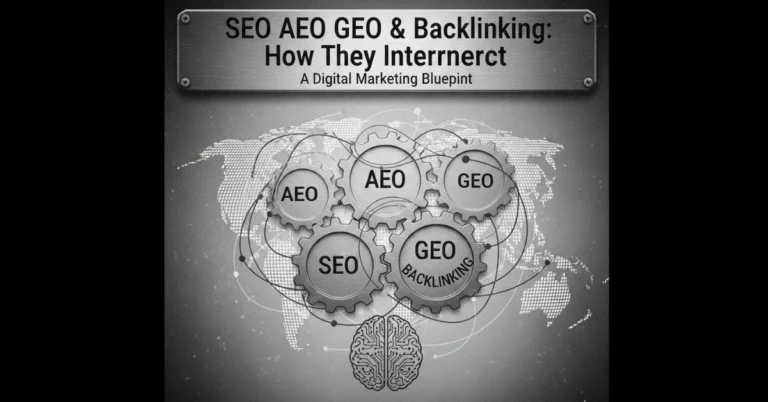
Read More: How SEO, AEO, GEO, and backlinking connect
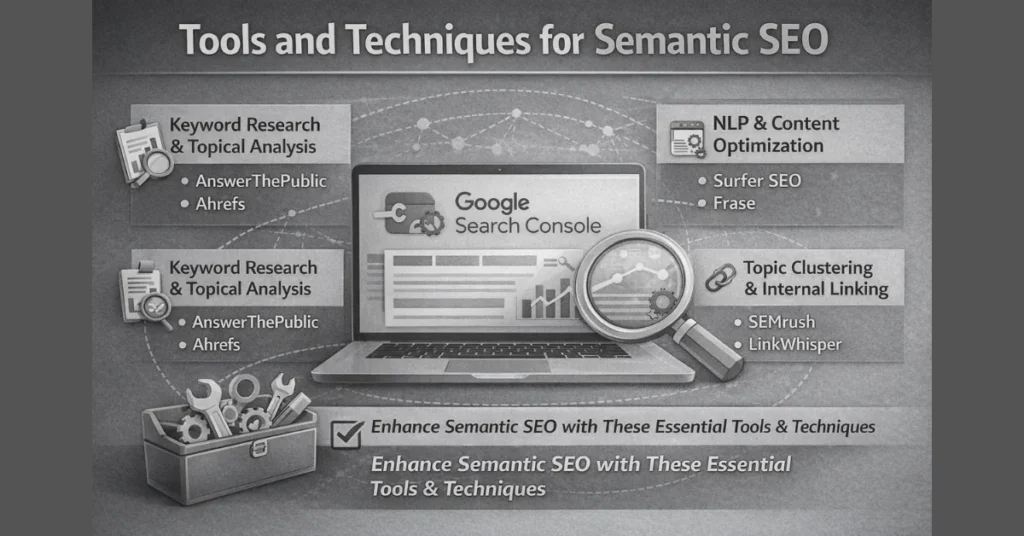
Implementing content clusters and semantic SEO effectively requires the right tools and strategies. By focusing on semantic search optimization, you can ensure your website covers topics comprehensively while building topical authority SEO.
Start with advanced tools like SEMrush and Ahrefs to identify primary and related keywords for both pillar and cluster pages. These tools help you uncover long-tail keywords and semantic variations, which are essential for topic clusters SEO. Using these tools ensures your content aligns with what users are actively searching for and covers all relevant aspects of your topic.
Tools like LSIGraph, Surfer SEO, and MarketMuse help identify semantically related keywords and phrases. By integrating these terms naturally into your content, you signal to Google that your pages are contextually rich and cover the topic in depth. This enhances both your SEO content structure and internal linking strategy.
Adding structured data to your pages helps search engines understand your content better. Implementing schema markup for articles, FAQs, and how-to guides supports semantic search optimization and improves visibility in rich search results.
Use content calendars and analytics tools to monitor the performance of both pillar and cluster pages. Track rankings, user engagement, and keyword performance to continuously refine your topic clusters’ SEO. Regular updates ensure your content stays relevant in line with the future of SEO 2026 trends.By combining these tools and techniques, your website can fully leverage content clusters and semantic SEO. This approach improves search engine understanding, strengthens your topical authority SEO, and provides a structured, user-friendly experience that keeps readers engaged.
Understanding content clusters and semantic SEO becomes much easier when you look at practical examples. Implementing a pillar and cluster model enables websites to thoroughly cover a topic while enhancing their topical authority and SEO.
In this example, each cluster page links back to the pillar page, and the pillar page links to all clusters, forming a strong internal linking strategy. This framework not only enhances your SEO content organization but also enables Google to interpret how different topics are connected clearly. Using semantic search optimization, each cluster page naturally targets related terms, expanding the site’s coverage of SEO-related queries.
Here, cluster pages explore specific aspects of the main topic. Interlinking ensures readers can navigate easily from general to detailed content, while search engines recognize the site as a comprehensive resource, boosting topic clusters’ SEO.
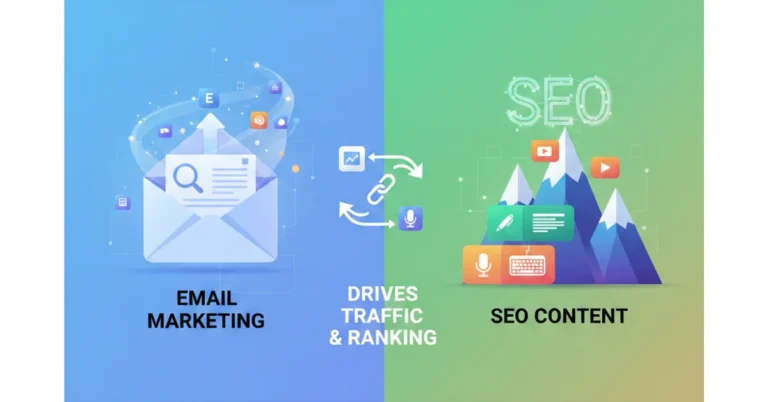
Read More: Email marketing to support SEO content
A simple diagram can make this concept clearer: place the pillar page at the center, and have cluster pages radiating around it like spokes. Each spoke links back to the center and, when relevant, to other spokes. This visualization illustrates your internal linking strategy and shows how semantic connections strengthen content clusters and semantic SEO. By following these examples, you can see how content clusters and semantic SEO work together to build a structured, authoritative website that ranks for multiple related queries while providing a seamless experience for visitors.
Even with content clusters and semantic SEO, there are common mistakes that can prevent your website from achieving maximum rankings and authority. Understanding and avoiding these pitfalls ensures your topic cluster’s SEO strategy is effective and sustainable.
One of the most frequent errors is producing cluster pages that are too short or lack depth. Content that lacks depth or usefulness can weaken your site’s authority and negatively impact SEO. Each cluster page should be comprehensive, actionable, and cover the subtopic thoroughly to complement the pillar page.
Some websites create random articles without connecting them through a pillar page. Skipping the pillar and cluster model results in poor SEO content structure and missed opportunities for internal linking. Properly linking cluster pages to the pillar and vice versa signals to Google that your site is authoritative and contextually relevant.
Without a clear internal linking plan, Google may fail to recognize how your content fits together. Be sure that every cluster page links to the pillar page and interconnects with relevant clusters. This strategy improves search visibility and keeps users easily moving through your content.
Failing to implement semantic search optimization limits your content’s visibility for related queries. Cluster pages should target semantically relevant terms, synonyms, and related topics to capture a wider audience and improve topic clusters’ SEO.
SEO evolves rapidly. Neglecting to update pillar and cluster pages can make your content outdated and reduce your topical authority SEO, especially considering trends in the future of SEO 2026. Regularly refreshing content ensures continued relevance and ranking performance, avoiding these mistakes and combining best practices for content clusters and semantic SEO, your website will achieve stronger authority, better rankings, and a more engaging experience for readers.
As search engines become smarter and more context-aware, the role of content clusters and semantic SEO will continue to expand in shaping effective ranking strategies. The future of SEO relies on AI-driven algorithms, machine learning, and enhanced understanding of semantic search optimization.
Websites adopting the pillar and cluster structure now are positioning themselves ahead for SEO success in 2026, as search engines place greater emphasis on content that reflects strong topical expertise and contextual depth.
In the near future, search engines will give preference to websites that organize their content using well-defined topic cluster SEO structures. Pillar pages supported by well-researched cluster pages signal authority and relevance, making it easier to rank for multiple related queries.
Maintaining a robust internal linking system between pillar and cluster pages will continue to be vital, allowing both users and search engines to explore and understand your content with ease.
AI-driven search also emphasizes context and intent over exact keyword matches. This means semantic optimization is no longer optional—each page must incorporate related concepts, synonyms, and contextually relevant information to fully satisfy user queries.
By adopting content clusters and semantic SEO, your site will naturally align with this shift, strengthening your SEO content structure and improving overall topical authority SEO.
Looking ahead, maintaining and updating clusters will be key. Websites that regularly refresh pillar and cluster pages with new insights, statistics, and trends will outperform static content.
By combining semantic search optimization with a structured content cluster approach, your site can future-proof its SEO strategy and stay ahead of competitors in 2026 and beyond. In short, content clusters and semantic SEO are no longer optional—they are essential for building authority, enhancing user experience, and ensuring long-term success in the evolving landscape of search.
Read More: AI vs human content writing in blogging
In 2026 and beyond, mastering content clusters and semantic SEO is essential for building a strong online presence and achieving topical authority SEO.
By combining pillar pages with supporting cluster pages and optimizing for semantic search, your website can provide comprehensive, contextually relevant content that satisfies both users and search engines.
By following these actionable steps, your website will not only rank higher in search results but also establish itself as an authoritative, trustworthy source in your niche. Implementing content clusters and semantic SEO ensures your content is structured, user-friendly, and future-proofed for evolving search engine algorithms.
Content clusters are groups of interlinked articles centered around a main topic, called a pillar page. The pillar and cluster framework enhances website structure, reinforces internal linking, and elevates topical authority SEO by showing search engines that your content delivers thorough coverage of a subject.
Semantic SEO, also known as semantic search optimization, emphasizes interpreting the intent and context behind user queries instead of merely targeting exact keyword matches. It helps your content rank for related terms, improves relevance, and aligns with AI-driven search algorithms.
By combining content clusters and semantic SEO, you create a structured content network where cluster pages support the pillar page and cover related subtopics. This strengthens your SEO content structure, improves topic clusters SEO, and enhances user experience.
The pillar and cluster structure features a main pillar page that provides comprehensive coverage of a broad topic, supported by several cluster pages that dive into related subtopics. All pages are interlinked, forming a clear internal linking strategy that helps search engines understand topic relationships.
Start by choosing a primary theme for your pillar page. After that, find relevant subtopics to develop as cluster pages, craft comprehensive content for each, and interlink them with the main pillar to create a cohesive structure. Incorporate semantic keywords and update content regularly to maintain topical authority SEO.
Tools like SEMrush, Ahrefs, LSIGraph, Surfer SEO, and MarketMuse help identify semantically related keywords and plan cluster topics. Using structured data and schema markup also improves semantic search optimization.