Physical Address
304 North Cardinal St.
Dorchester Center, MA 02124
Physical Address
304 North Cardinal St.
Dorchester Center, MA 02124
Imagine a world where AI can write your entire blog in minutes, optimize it for search engines, and even predict what your audience wants to read next—but does that mean human writers are becoming obsolete? This is the heart of the controversial debate: AI vs human content writing. With the rise of AI search, voice search, and zero-click results, content discovery is changing, and bloggers must create posts that are both informative and structured to appear in featured snippets.
As Google emphasizes E-E-A-T (Experience, Expertise, Authority, Trustworthiness) and Answer Engine Optimization for 2026, understanding the strengths of AI and human content is critical. AI content vs human content shows that AI excels at speed, scale, and SEO structure, while humans bring creativity, nuance, and credibility. Blogging with AI combines the efficiency of AI writing tools with human editing to maximize engagement and authority.
Before choosing a strategy, reflect on your goals: if you aim for high-volume, SEO-driven traffic, AI drafts help save time; if you prioritize brand voice and storytelling, human writers are essential; or a hybrid approach may be the best way to dominate SEO 2026, voice search, and featured snippet opportunities.
Read More: AI keyword research for Bloggers
AI content writing uses advanced AI writing tools like ChatGPT, Jasper, and Writesonic to automatically generate blog posts, articles, and marketing copy. In blogging with AI, these tools help writers produce content quickly, scale output efficiently, and optimize structure for SEO 2026, voice search, and Answer Engine Optimization. AI-generated content can also be structured to appear in zero-click searches and featured snippets, increasing visibility and reach.
AI content writing offers significant advantages, especially when speed, efficiency, and SEO optimization are priorities:
Actionable Tip: Utilize AI tools to quickly draft content or generate topic ideas, then refine them to align with your brand’s voice.
Despite its advantages, AI has limitations that can impact content quality and authority:
Practical Interconnection: While AI content excels at SEO 2026 strategies, featured snippets, and AI-driven search, it relies on human writers to maintain E-E-A-T, creativity, and trustworthiness. Combining AI efficiency with human refinement ensures content is both fast and authoritative.
Read More: Content strategy for topical Authority
Human content writing is the traditional process of creating content through research, drafting, and editing by skilled writers. Human writers bring creativity, expertise, and a personal voice, which AI alone cannot replicate. In the era of SEO 2026 and Answer Engine Optimization, human content ensures higher E-E-A-T—Experience, Expertise, Authority, and Trustworthiness—making it more likely to engage readers and perform well in search results. Humans also optimize content for voice search and featured snippets, but with a richer narrative and nuanced context that AI often misses.
Human content offers unique advantages that enhance credibility, engagement, and reader trust:
Actionable Tip: Use human writers to refine AI drafts, add storytelling elements, and ensure content aligns with your brand’s voice and authority.
While highly valuable, human content also has limitations in speed and scalability:
Practical Interconnection: Human writers complement AI content vs human content strategies by adding creativity, nuance, and authority. When combined with AI-generated drafts, this hybrid approach maximizes both efficiency and quality, enabling bloggers to dominate SEO, voice search, and featured snippet opportunities in 2026.
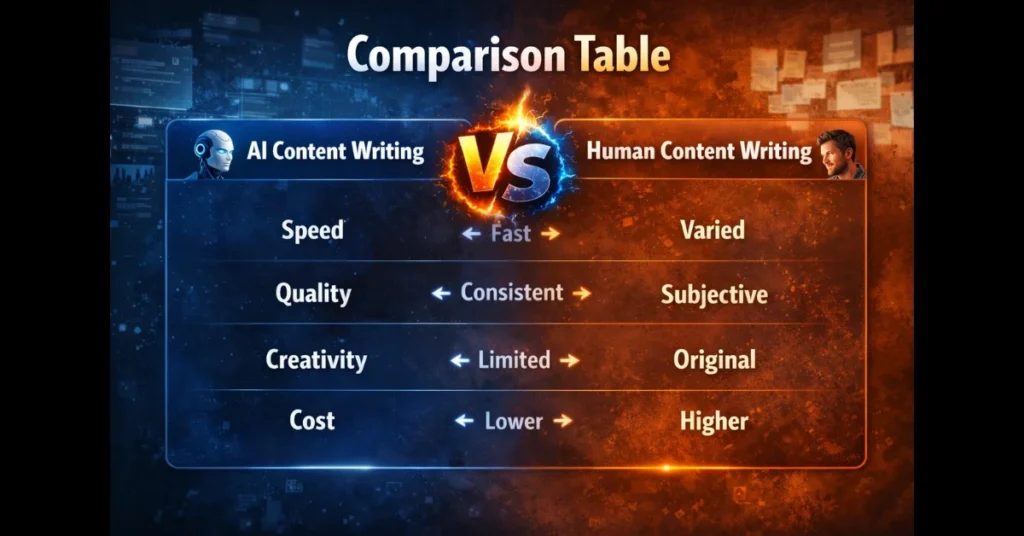
The debate of AI vs human content writing isn’t about one being better than the other—it’s about understanding their strengths and how they complement each other. AI excels in speed, scalability, and SEO optimization, while humans bring creativity, nuance, and authority. Using both strategically ensures content performs well in SEO 2026, voice search, featured snippets, and Answer Engine Optimization.
| Feature | AI Content Writing | Human Content Writing |
| Speed | Very fast; drafts multiple posts in minutes | Slower; depends on research and editing |
| Creativity | Limited; struggles with storytelling | High adds nuance, voice, and emotional depth |
| Cost | Low reduces the need for multiple writers | Medium to high-skilled writers cost more |
| SEO Optimization | Excellent for keywords, snippets, and structure | Requires effort but enhances E-E-A-T and context |
| Emotional Connection | Low; may feel robotic | High: builds trust and engagement |
| Accuracy & Expertise | Needs human verification | Generally reliable and authoritative |
| Voice Search & Featured Snippets | Can structure for snippets | Adds nuance and context for human-friendly results |
Actionable Tip: Combine AI and human writing for maximum impact:
Practical Interconnection: AI and human writers are not competitors—they are collaborators. A hybrid strategy leverages AI efficiency while maintaining human credibility, resulting in content that ranks well, engages readers, and dominates SEO 2026 trends.
Read More: AI Tools for Content Creation
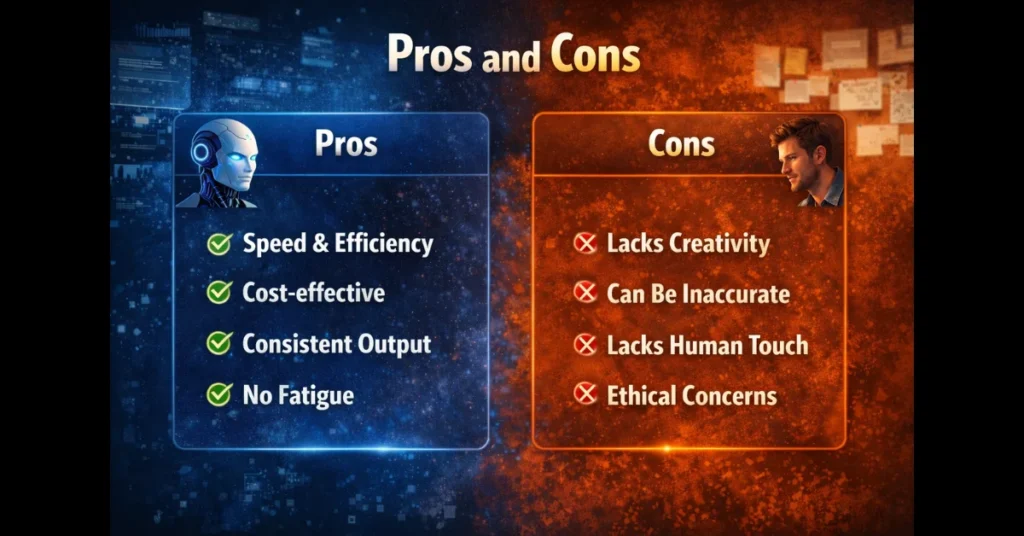
| Feature | AI Content Writing – Pros | AI Content Writing – Cons | Human Content Writing – Pros | Human Content Writing – Cons |
| Speed | Very fast; drafts multiple posts in minutes | May require human edits to finalize | Slower; depends on research and writing | Time-consuming; slower content production |
| Cost | Low reduces the need for multiple writers | Over-reliance can reduce authenticity | Medium to high; invests in skilled writers | Higher cost for consistent quality |
| SEO Optimization | Structured for keywords, featured snippets, and voice search | Needs verification and human refinement for context | Improves E-E-A-T, authority, and nuance | Requires effort to optimize for SEO and snippets |
| Creativity & Storytelling | Can generate ideas, but limited storytelling | Lacks emotional depth and nuance | High creativity; strong storytelling | Quality depends on the writer’s skill |
| Trust & Authority | Efficient for large-scale SEO content | Can feel robotic or generic; lower trust | Builds authority and credibility; authentic | Slower to build scale and volume |
| Engagement | Consistent tone and format | May fail to connect emotionally | Strong reader connection; flexible tone | Subjective; depends on audience alignment |
Actionable Tip: Use a hybrid approach—AI for drafts and structure, humans for refinement, storytelling, and E-E-A-T compliance—to get the best of both worlds.
When it comes to AI vs human content writing, both have clear strengths. AI content delivers speed, scalability, and SEO optimization, making it ideal for drafting posts, targeting keywords, and structuring content for featured snippets, voice search, and zero-click results. Human content excels in creativity, storytelling, and authority, ensuring strong E-E-A-T, credibility, and reader engagement.
The best approach is a hybrid strategy: start with AI-generated drafts and outlines, then refine them with human editing to add expertise, nuance, and brand voice. This combination maximizes efficiency, quality, and visibility in modern SEO.
AI content writing uses AI writing tools like ChatGPT, Jasper, or Writesonic to generate blog posts, articles, and marketing copy automatically. It helps with speed, keyword optimization, and creating drafts for blogging with AI.
Not yet. AI is efficient for drafts, research, and SEO optimization, but it lacks creativity, emotional depth, and brand voice. The most effective strategy combines AI efficiency with human refinement—a hybrid approach.
Produces content quickly and at scale. Optimizes for SEO 2026, voice search, and featured snippets. Generates topic ideas and outlines. Helps maintain consistent formatting and structure
Creative storytelling and engaging narratives. Expert insights that improve E-E-A-T. Builds trust, authority, and brand personality. Flexible tone adaptable to different audiences.
Combining AI and human content ensures fast production, SEO-optimized structure, and authoritative, engaging content. It increases chances of appearing in zero-click searches, featured snippets, and performing well on voice search platforms.
Yes. A hybrid approach leverages AI writing tools for efficiency and human writers for creativity and credibility, making it the most effective strategy for SEO 2026 and audience engagement.