Physical Address
304 North Cardinal St.
Dorchester Center, MA 02124
Physical Address
304 North Cardinal St.
Dorchester Center, MA 02124
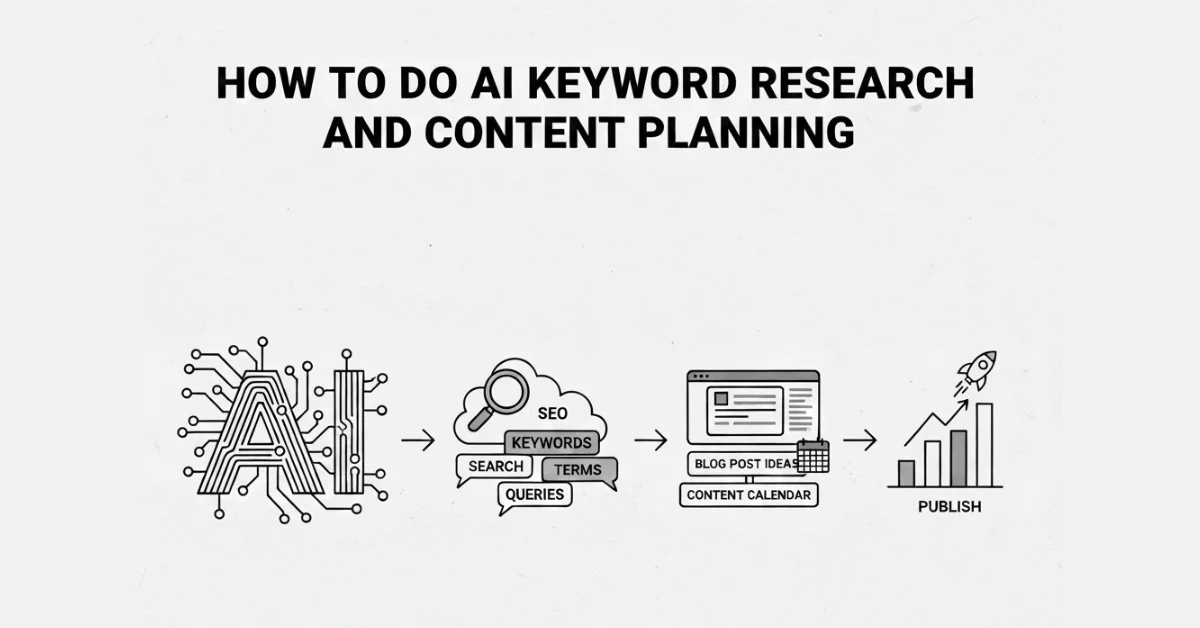
In the modern digital landscape, succeeding in SEO takes more than simply predicting which keywords might work best. AI keyword research and content planning have revolutionized the way bloggers, freelancers, and small businesses approach content strategy.
By leveraging artificial intelligence, you can quickly discover high-potential keywords, understand search intent, and map out a content plan that drives traffic and engagement—all while saving valuable time. Whether you’re new to SEO or looking to optimize your current strategy, AI tools offer a more innovative, faster, and more accurate way to grow your online presence.
The rise of AI has fundamentally changed how SEO professionals and content creators approach keyword research and content planning. Here’s why it matters:
Read More: Building content clusters with keywords
Selecting the right tools is essential when leveraging AI for keyword research, and content strategy tools can help you uncover hidden opportunities, generate keyword ideas, and analyze competition much faster than manual research. Here’s a quick comparison of the leading free and paid choices.
✅ Tip: Free tools are perfect if you’re just starting, on a budget, or exploring new content ideas.
✅ Tip: Paid tools are worth the investment if you want advanced AI features, competitive analysis, and detailed content planning—especially for freelancers, agencies, or small businesses aiming for higher ROI.
Summary:
Best practice: Combine both types—use free tools for idea generation, then refine and optimize with paid AI tools for maximum SEO impact
Read More: AI-assisted content planning
Once you’ve gathered the right keywords, the next step is to turn those keywords into a smart content plan. AI doesn’t just help with finding words—it helps you understand what your audience wants, which topics to focus on, and even when to publish for maximum impact.
AI can be a great brainstorming partner. Instead of guessing what your audience is searching for, AI tools can:
Think of it as an AI assistant tuned in to your audience’s interests and curiosities. You give it a seed keyword, and it helps you uncover a whole world of content possibilities.
Not all keywords should live in isolation. AI can group related keywords into clusters, which makes your content more organized and SEO-friendly.
For example, if your pillar topic is “AI in SEO,” cluster content could include:
This approach helps Google understand your site’s structure and makes it easier for your readers to navigate related topics.
Once your topic clusters are set, AI can organize an optimized publishing schedule using a content calendar.
With AI, you can even get recommendations on post frequency and optimal publishing dates, making your content strategy more data-driven instead of guesswork.
💡 Tip: Don’t let AI completely take over. Always add your personal insights and human touch—your unique voice is what keeps readers engaged and coming back.
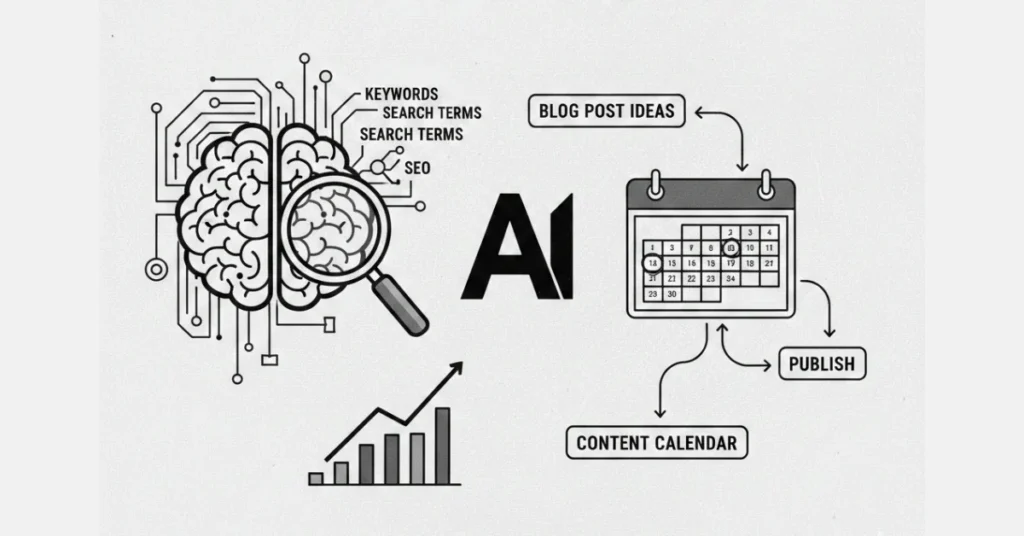
Using AI tools for keyword research and planning can dramatically enhance the way you produce content. It’s not just about finding keywords faster—it’s about building a smarter, data-driven content strategy that saves time, improves rankings, and helps your content reach the right audience. Let’s explore the main benefits:
Manually researching keywords and planning content can take hours or even days. AI tools can:
With AI, you can focus your energy on writing high-quality content and engaging your readers.
Long-tail keywords are often overlooked in traditional SEO. AI can:
Especially helpful for smaller players and freelancers navigating competition from larger websites.
By analyzing trends and search intent, AI assists in mapping out a content plan that aligns with your audience’s needs. Benefits include:
Consistent, high-quality content guided by AI can:
💡 Pro Tip: While AI is a powerful tool, always combine it with your personal insights and unique voice. This ensures your content is engaging, authentic, and reader-friendly.
Read More: Amazon-focused keyword research
The success of AI-powered keyword research and content strategy depends on choosing the right tools. Depending on your goals, budget, and level of expertise, you may prefer free tools, paid tools, or a combination of both. Let’s break it down.
Free tools are ideal for beginners or anyone testing AI-driven keyword research and content planning. They can:
Examples of free tools: Google Keyword Planner, AnswerThePublic, ChatGPT.
💡 Tip: Free tools are perfect for freelancers or bloggers with a small budget who need quick keyword ideas and content suggestions.
Paid AI tools offer advanced features, deeper insights, and time-saving automation. You should consider investing in them if you want to:
SEMrush, Ahrefs, Surfer SEO, and Clearscope are among the top paid tools available.
✅ Pro Tip: Paid tools are ideal for freelancers, agencies, or small businesses aiming for faster results and better ROI.
Investing in AI tools is not just an expense—it’s a strategic investment in your content strategy. Here’s why:
| Type of Tool | Pros | Cons |
| Free Tools | – No cost, great for beginners.- Quick keyword ideas and topic suggestions.- Easy to experiment with content planning. | – Limited keyword data and insights.- Fewer advanced features.- May require manual clustering and analysis. |
| Paid Tools | – Advanced keyword analysis and AI-driven insights.- Competitive research and content optimization.- Time-saving automation for content planning. | – Can be expensive for small budgets.- Learning curve for beginners.- Over-reliance may reduce creative input. |
💡 Remember: You don’t have to choose one or the other. Many successful content creators use a mix of free and paid tools to balance cost and performance.
While AI keyword research and content planning can save time and improve results, many beginners make avoidable mistakes that hurt both rankings and content quality. Understanding these drawbacks ensures you use AI efficiently to deliver the best performance for your business or blog.
AI can generate keywords, clusters, and even draft content, but it cannot replace human judgment.
✅ Pro Tip: Treat AI as your assistant, not the author. Your insights add credibility and authenticity.
AI tools, no matter how powerful, sometimes overlook the purpose behind a search term.
💡 Actionable Tip: Analyze intent manually for each keyword suggested by AI to ensure alignment with your audience’s needs.
Keyword stuffing is a common mistake, especially when using AI:
AI streamlines content planning, but audience interests and search patterns shift over time.
✅ Pro Tip: Use AI to suggest updates and improvements, but always add a human touch to keep content current and engaging.
Summary:
Avoid these mistakes, and your AI keyword research and content planning efforts will be much more effective. Remember, AI works best when combined with human insight, careful planning, and ongoing optimization.
Seeing real examples of AI-driven keyword research and content planning makes it easier to apply the method successfully. Let’s look at a practical example of a freelancer using AI to boost their blog traffic and organize content strategy.
Sara is a freelance blogger specializing in technology. She struggled with:
She decided to implement AI keyword research and content planning to improve her workflow and results.
Sara combined free and paid AI tools for maximum efficiency:
After three months of consistent AI-assisted content planning:
💡 Key Takeaway: Combining AI tools with human insight allowed Sara to scale her content strategy efficiently, attract more readers, and improve rankings—all without spending excessive time on manual research.
This case study demonstrates that AI keyword research and content planning are not just theoretical—it can deliver real, measurable results when applied correctly.
Read More: Best AI SEO tools for keyword research
The SEO landscape is always changing, with AI-driven keyword research and content planning leading the way. Understanding how AI will shape the future helps freelancers, bloggers, and small businesses stay ahead of the curve.
Google’s algorithms are becoming increasingly sophisticated, and AI plays a key role in this evolution:
Experts predict several trends in AI keyword research and content planning:
Early adopters of AI in SEO gain a significant advantage:
💡 Actionable Tip: Start integrating AI into your workflow today, even in small steps. Use AI for keyword research, content planning, and optimization to stay ahead and improve ROI.
In today’s competitive digital world, mastering AI keyword research and content planning is crucial for building a strong and sustainable SEO strategy. When you blend AI technology with human creativity, you can:
While AI brings automation and precision, the human touch adds creativity, emotion, and strategy—elements that technology alone cannot replicate. Combining both ensures your content remains engaging, authentic, and impactful.
AI keyword research leverages artificial intelligence to identify the search terms your target audience actively looks for online.
Unlike traditional methods, AI can:
Analyze search trends in real time.
Provide targeted long-tail and niche keyword ideas.
Group similar keywords together to enhance content planning.
This approach helps you save time and make data-driven content decisions.
AI is powerful, but it cannot fully replace human SEO expertise. AI can:
Generate keyword ideas and clusters.
Suggest content optimization strategies.
However, humans are needed to:
Interpret data.
Ensure content aligns with brand voice.
Make creative decisions and evaluate search intent.
Tip: Think of AI as a helpful teammate—it enhances your abilities rather than taking over.
Small businesses can use AI-driven keyword research and content planning to:
Quickly find high-potential keywords for their niche.
Build a structured content strategy without hiring a full team.
Optimize posts for better rankings and traffic.
Even a combination of free and affordable AI tools can make a huge difference.
Some of the leading AI solutions for keyword research and content planning are:
Free: Google Keyword Planner, AnswerThePublic, ChatGPT.
Paid: SEMrush, Ahrefs, Surfer SEO, Clearscope.
💡 Pro Tip: Use a mix of free and paid tools to balance cost, insights, and efficiency.
Small businesses can use AI-driven keyword research and content planning to:
Quickly find high-potential keywords for their niche.
Build a structured content strategy without hiring a full team.
Optimize posts for better rankings and traffic.
Even a combination of free and affordable AI tools can make a huge difference.