Physical Address
304 North Cardinal St.
Dorchester Center, MA 02124
Physical Address
304 North Cardinal St.
Dorchester Center, MA 02124

How to increase domain authority is one of the most common questions asked by bloggers, marketers, and website owners who want better search rankings. Domain Authority (DA) is a ranking score created by Moz that estimates a website’s potential to appear higher in Google search results.
Although Google itself does not use DA as an official ranking factor, a higher score usually indicates stronger backlinks, higher-quality content, and better overall SEO performance.
If your website is new or has a low DA score, you might feel it’s difficult to compete with established sites. The truth is, increasing domain authority takes time, but it can be achieved through consistent SEO strategies, link building, and content optimization.
In this guide, we’ll cover
A dedicated FAQ section is designed to address the most common questions. By the end, you’ll have a clear, actionable roadmap on how to increase domain authority and grow your site’s credibility in search results.
Read More: Backlinking strategies for higher Authority

How to increase domain authority starts with understanding what Domain Authority (DA) actually is. Developed by Moz, the Domain Authority (DA) score estimates a site’s ranking strength on SERPs. Websites are rated from 1 to 100, with higher values showing greater authority and visibility potential.
Domain Authority and Page Authority serve different purposes: DA scores the entire domain’s influence, while PA measures how strong a single page is in search rankings. Both metrics are essential, but DA gives an overall picture of your website’s credibility in search engines.
Grasping how Domain Authority works helps you set achievable SEO goals and monitor your site’s progress as you steadily apply strategies to boost its DA. Tools like the Moz Domain Authority checker, Ahrefs, and SEMrush can help you monitor your site’s authority regularly.
The first step in improving your Domain Authority is learning how the score is formed. Moz’s DA metric predicts ranking potential on a logarithmic scale between 1 and 100—higher values indicate stronger credibility and a better chance of ranking for challenging keywords.
Several key factors influence domain authority:
Monitoring your DA with tools like Moz, Ahrefs, and SEMrush helps you stay aware of your site’s growth. Frequent checks make it easier to refine strategies and strengthen weak points. By knowing how DA is calculated, you can implement the right strategies to increase the DA of your website strategically and avoid wasting time on ineffective tactics
Read More: Topical Authority with Content Clusters
How to increase domain authority takes consistent effort paired with strategic actions. Below are key methods to raise your DA effectively.
Tips for building backlinks:
Content drives domain authority growth. Websites that consistently provide unique, informative, and comprehensive posts are more likely to gain backlinks organically.
Tips for content optimization:
Technical SEO focuses on making your website easy for both users and search engines to access and understand, which can greatly improve your Domain Authority.
Essential technical elements include:
Improving on-page SEO ensures your content is clear, relevant, and search-friendly — a major factor in growing your DA.
Recommendations:
You don’t always need paid tools or strategies to increase the DA of your website.
Free methods:
By consistently applying these strategies—high-quality backlinks, SEO-friendly content, and technical and on-page SEO—you’ll gradually see improvements in your domain authority.
Read More: Technical SEO issues like 404 errors
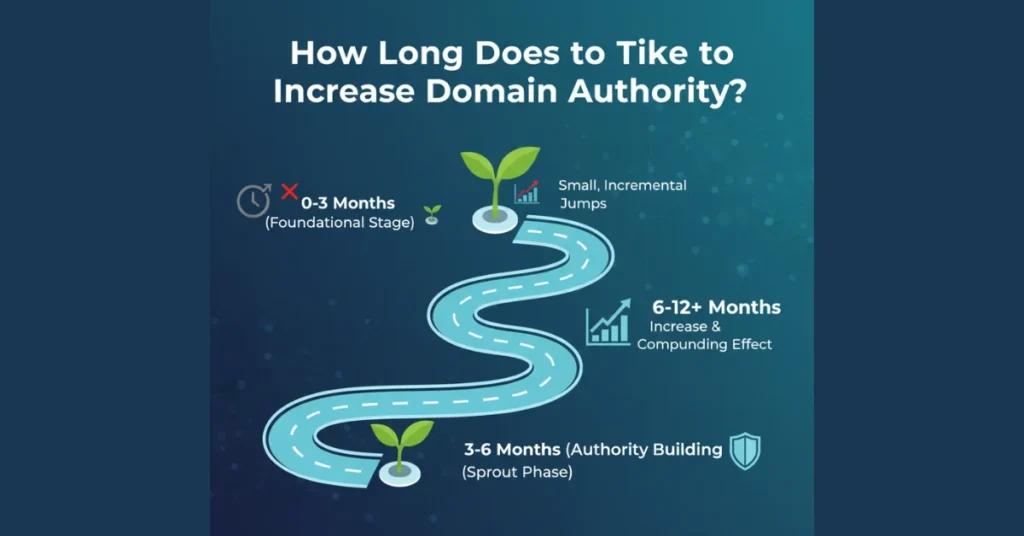
How to increase domain authority effectively requires patience, as it is a gradual process rather than an overnight fix. Domain Authority is calculated based on factors like backlinks, content quality, and technical SEO, all of which take time to develop and impact your score.
While there is no exact formula for how quickly you can increase your DA, focusing on high-quality backlinks, on-page SEO, and valuable content ensures steady progress over time.
How to increase domain authority becomes much easier when you track your progress and analyze your website’s strengths and weaknesses. Several tools can help you monitor domain authority and identify areas for improvement.
Moz developed the DA metric, and their Domain Authority Checker is the most popular tool for measuring your website’s score. It helps you,
Ahrefs uses Domain Rating (DR), which is similar to DA. It focuses on the quality and quantity of backlinks your website has. Using Ahrefs, you can:
SEMrush offers an Authority Score, a metric that evaluates a website’s overall SEO performance and credibility. With this tool, you can:
By regularly monitoring your DA using these tools, you can make informed decisions to increase the DA of your website effectively. Combining tracking with consistent SEO efforts ensures continuous growth in your website’s authority.
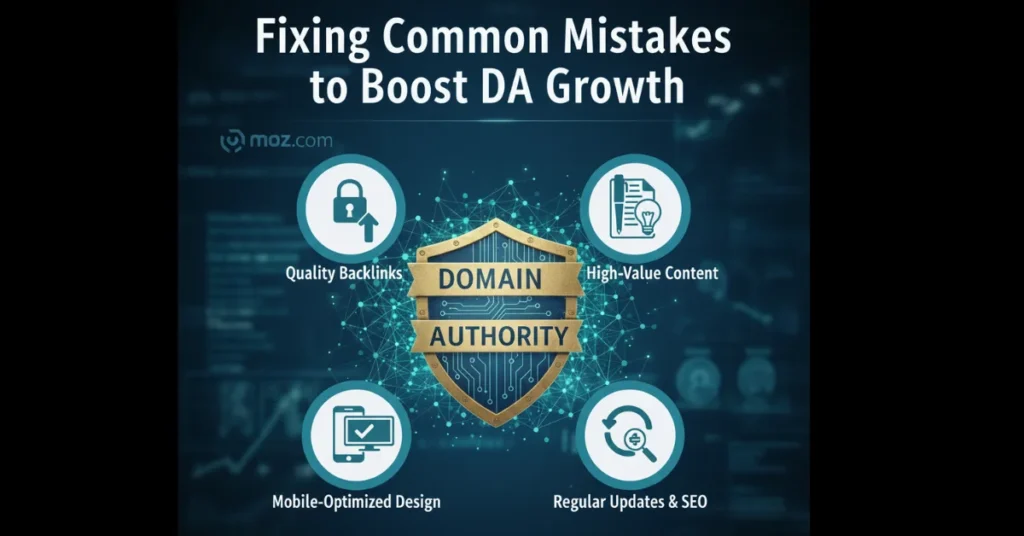
How to increase domain authority requires not only following best practices but also avoiding common mistakes that can hold your website back. Here are some of the biggest pitfalls
By avoiding these mistakes and focusing on quality content, backlinks, and technical SEO, you can steadily boost your domain authority over time.
Read More: Content promotion through email marketing
How to increase domain authority is an ongoing effort rather than a one-time task, involving consistent SEO optimization, quality content production, and strategic link-building.
By following the strategies outlined in this guide—building high-quality backlinks, creating SEO-friendly content, optimizing technical and on-page SEO, and avoiding common mistakes—you can steadily boost your domain authority over time.
Keep in mind that Domain Authority reflects your website’s trustworthiness and credibility. While noticeable improvements may take several months, the long-term benefits include higher search rankings, more organic traffic, and greater brand visibility.
Regularly track your DA with tools such as Moz Domain Authority Checker, Ahrefs, or SEMrush to measure progress and fine-tune your strategies. Stay patient, remain consistent, and focus on delivering valuable content to your audience.
By following these steps, you’ll gradually strengthen your site’s authority and overall SEO performance.
While there’s no overnight solution, you can accelerate results by focusing on high-quality backlinks, publishing SEO-optimized content, and maintaining strong technical SEO. Maintaining consistency is essential for steadily increasing your Domain Authority.
Yes! You can improve your DA without paid tools by creating original content, building relationships for backlinks, sharing your articles on social media, and participating in relevant communities like Quora or forums.
No—Domain Authority is a metric from Moz, not Google. Still, sites with higher DA often rank better because they tend to have strong content, quality backlinks, and well-implemented SEO.
20–30: New websites.
40–60: Established websites.
60+: High-authority sites in competitive niches.
Monthly checks are sufficient. DA changes gradually, and frequent checks are not necessary. Focus on implementing strategies consistently for steady improvement.
It usually takes 3–6 months for small improvements, while significant increases can take 12–24 months, depending on competition, content, and backlinks.